Your first punch in KO Million is the moment the multiplier leaves x1.00 behind. KO Million, built by InOut Games as a quick-fire instant title, turns that opening jab into the start of a climb: every blow you land carries the round one step higher, and every step lifts the multiplier a little further.
There is a catch, and it sits at the centre of the design. Somewhere along the path, a knockout may be waiting. It can arrive on the very first punch or deep into the sequence, and when it lands, the stake is gone. Nothing on the way up reveals where it hides.
Each round therefore becomes a quiet negotiation between two impulses. One urges you to keep swinging, because the next step is worth more. The other suggests taking what is already in front of you.
You decide which voice wins. Collecting is allowed whenever you like, and the multiplier you hold at that instant is the one applied to your stake.
What follows sets out the full picture: who made the game and what drives it, the theme, the quartet of difficulty settings, the official figures, the fairness tools, where real-money play is permitted and how to keep sessions in proportion.
KO Million in brief
KO Million is a 2026 release from InOut Games. It belongs to the instant-game category, which means no spinning symbols, no lines to track and nothing lengthy to configure. A round opens, runs its course in a short span and closes with either a payout or a lost stake.
Beneath the boxing artwork lies a mechanic the studio calls Step Multiplier. The principle is easy to grasp. Rather than drifting upward along a smooth curve, the value moves in distinct increments, and each increment is tied to an action you take. Here, that action is a punch.
That structure places the title in the crash family. The central question is when to stop, and a bust can arrive without any warning sign.
What sets the pacing apart is the counting. Because progress is measured punch by punch, you always know how far along the path you have travelled. There is no sense of a number racing away from you; the round only advances when another punch is thrown.
Rounds are self-contained. Whatever happened last time leaves the following round untouched, and a cluster of early defeats does not tilt the odds toward a long climb later on. Each new KO Million round resets to x1.00, with the path ahead unknown.
A boxing game seen in first person
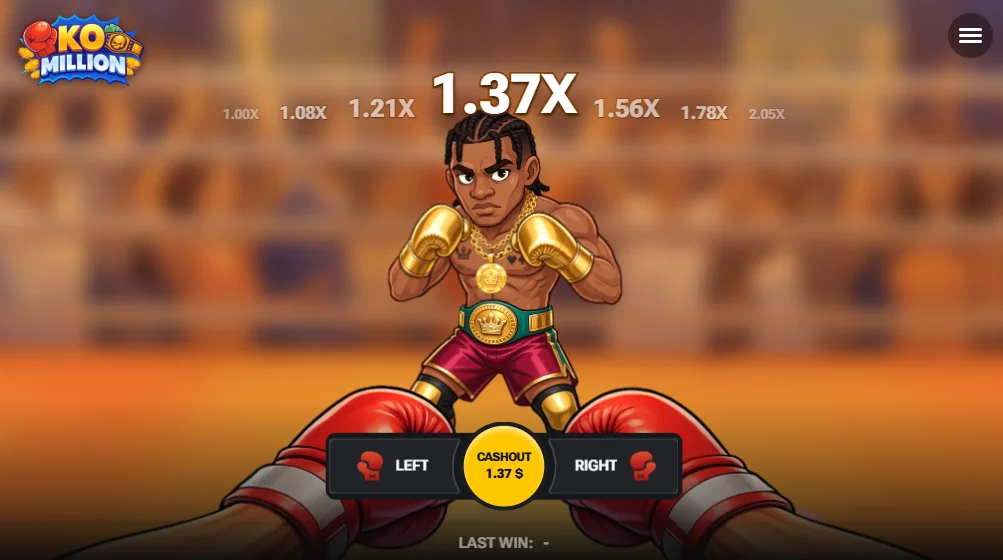
The view puts you inside the fight. In KO Million the camera sits behind your own eyes, so the opponent stands directly ahead and every punch leaves from your position.
Four challengers are on offer. Each one is identified by the emblem on its belt, and there are four to recognise: lion, crown, skull and snake. The symbols act like name badges, letting you tell at a glance which opponent you are facing.
In KO Million, choosing an opponent is not a cosmetic decision. Each mode is tied to its own fighter and to its own ladder of multipliers, so selecting a mode also settles who stands across from you. A gentle path goes with one challenger, a far steeper one with another.
The theme serves the mechanic rather than competing with it. A punch is a step, a knockout is a lost round, and the belt tells you which path is in play. That direct mapping keeps the rules readable even for someone loading the game for the first time.
It also keeps attention where it belongs: on the multiplier and on the single decision that shapes every round, which is how many more punches to throw before collecting.
How a round works
- Set your stake. By default, KO Million lets each round be staked at NZ$0.22 minimum and NZ$360 maximum, although the casino hosting it may apply other limits.
- Pick Easy, Medium, Hard or Hardcore. That selection determines your opponent and the multiplier path waiting for you.
- Start the round. The multiplier always begins at x1.00.
- Throw a punch. A successful one advances you by exactly one step, nudging the multiplier higher.
- Decide again after every step. You can collect the current multiplier or keep going.
- Only two endings exist. You either take the cash-out and receive the stake times the value reached, or a knockout lands and nothing of the stake comes back.
A short example makes the arithmetic concrete. Imagine a NZ$3.6 stake in Easy mode, cashed out when the multiplier reads x1.50. The return is NZ$5.4.
Treat that x1.50 purely as an illustration picked to make the sum easy. No particular step of the Easy path is implied by it, and it should not be read as a suggested exit point.
Notice that step six offers no middle ground. A knockout does not leave part of the stake behind, and the height reached beforehand makes no difference at all. Only a cash-out converts progress into money.
That is also why steps two and five carry so much weight. The mode decides how sharply the numbers rise, while your own timing decides whether any of that rise reaches your balance. Nothing in the game makes the timing decision for you.
Four difficulty modes in KO Million
| Mode | Steps | Multiplier range |
|---|---|---|
| Easy | 30 | x1.01, peaking at x23.24 |
| Medium | 25 | x1.08, peaking at x2,457 |
| Hard | 22 | x1.18, peaking at x62,162.09 |
| Hardcore | 18 | x1.44, peaking at x3,608,855.25 |
Read the rows in order and two trends show up side by side: the path gets shorter while the numbers grow dramatically. Easy offers 30 steps, its first value of x1.01 barely above the stake and its ceiling at x23.24. Medium trims the count to 25, so its path is shorter, yet it climbs from a base of x1.08 to a peak of x2,457. Hard runs for 22 steps, whose first value is x1.18 and whose last is x62,162.09. Hardcore is the shortest of all at 18 steps, with its opening value at x1.44 and its summit at x3,608,855.25. A steeper path gives every single punch more weight, and volatility climbs with difficulty as a direct result, so outcomes in the tougher settings swing further apart from one round to the next. Picking among them is a question of how much risk you want, not of how skilled you are, because nothing you do with your fists changes where a knockout falls. What the mode shapes is how the uncertainty is spread across the path. Bear in mind too that the summit of the Hard and Hardcore paths can sit above the amount KO Million will actually hand over in one round, a point covered in the section on the win cap.
Cashing out and holding to keep punching
Two controls shape the rhythm of every round: the decision to stop and the option to keep punches flowing without pause.
Cash-out
Cashing out is the only route from a climb to a payout. You may use it at whatever point you choose mid-round, and your stake is multiplied by whatever value is displayed then.
Leaving early carries no penalty. A knockout, on the other hand, wipes out the full stake, whatever value had been reached.
That imbalance is the reason it pays to settle on a target before the first punch rather than in the middle of the action, when choices tend to become hurried.
Continuous play
Keep the spacebar pressed, or hold Play down when using a phone, and punches follow one after another. The chain stops only when you halt it or when you are knocked out.
This makes rounds noticeably quicker. It also removes the brief pause that single punches leave for second thoughts.
If you rely on it, fix your exit point ahead of time. A held key will not stop to ask whether you are certain, and fast rounds can make a session feel shorter than it really is.
RTP, volatility and the win cap
- RTP: 95.4%. This is a theoretical figure that only takes shape across an enormous sample of rounds. It tells you about KO Million overall, never about what tonight's session will bring.
- Volatility: depends on the mode chosen. Tougher settings mean bigger swings, so Hard and Hardcore behave far more erratically than Easy.
- Maximum win: no single round pays out beyond NZ$36,000.
- Bonus features: none. No bonus round exists, and there is nothing to buy your way into; every payout comes from the climb itself.
The cap deserves a careful look because the multiplier paths reach so high. In Hardcore, the top value of x3,608,855.25 goes far beyond what a NZ$36,000 ceiling allows, even at the smallest default stake. Depending on your bet, the same can happen in the upper part of Hard and Medium too. Whatever multiplier a round displays, the amount credited stays within NZ$36,000. Once a potential payout passes that line, any further steps add risk without adding reward. Before pushing toward the top of a path, multiply your stake by the multiplier in view and compare the result with the limit. It takes a few seconds and can stop you from fighting for money the game will not pay.
Stake range in KO Million
Absent any operator adjustment, the smallest permitted bet per round is NZ$0.22, while NZ$360 marks the upper end. Casinos are allowed to adjust those bounds, so the figures you meet in the lobby can differ from the defaults.
The right stake is the one your budget can absorb many times over. A small bet stretches a session across more rounds, which leaves room to explore the different modes without draining your funds quickly.
Larger stakes change the picture in another way. Because the win cap is fixed in currency rather than as a multiplier, a bigger bet runs into the ceiling at a lower step. On the harder modes, that point can come well before the end of the path.
There is no stake that improves the odds. Size changes only how much each outcome is worth, so the decision belongs to your budget rather than to any hunch about the next round. If a session has gone badly, lowering the bet is a sensible reaction; raising it to win back what was lost is not.
Provably fair rounds in KO Million
Provably fair technology sits behind every KO Million round, allowing players to confirm that nothing about a finished round was changed afterwards. Two pieces of information are central to this: a server seed and a client seed. Both are displayed in the game's settings.
When a round is over, the bet history keeps a record of it you can examine. That gives you a means of checking results yourself instead of simply trusting what appeared on screen.
The check works in one direction only. It shows that a result was fixed and untouched; it cannot tell you anything about the punch that will follow. Every punch remains random, and no pattern in previous rounds predicts the next outcome.
That point matters because past results often look meaningful. Losing several rounds early can feel like a sign that a long climb is due, while a series of deep rounds can feel like a streak worth riding. Neither impression holds. The history is a record, not a forecast.
Use it the way it is intended: as a means of confirming fairness and keeping track of what you have staked, not as raw material for predicting the future.
Free demo and devices
Une version gratuite de KO Million apparaît sur de nombreux sites de casino, bien que la disponibilité d'une démo varie d'un opérateur à l'autre. Les tours d'entraînement suivent les mêmes règles que les payants, avec des crédits de jeu à la place de l'argent.
La démo est l'endroit où les modes sont le mieux compris. Regarder la rapidité à laquelle les nombres augmentent dans Hardcore par rapport à Easy enseigne plus que n'importe quel tableau, et cela ne coûte rien.
Les crédits de démo n'ont aucune valeur monétaire, donc un bon parcours là ne dit rien sur ce que les tours payants apporteront. Considérez-le comme une répétition pour des décisions plutôt qu'un aperçu des résultats.
Parce que le jeu est écrit en HTML5, il se lance dans n'importe quel navigateur récent sur mobile ou ordinateur de bureau, sans logiciel à installer. Une connexion stable aide, en particulier lorsque vous devez continuer à taper, car un signal perdu est indésirable en plein milieu d'une montée.
Sur les écrans tactiles, maintenir le bouton Play remplace le maintien de la barre d'espace. L'écran plus petit laisse moins de place à la distraction, mais cela peut également rendre les tapotements rapides plus difficiles à évaluer, donc faites une pause brièvement avant de vous engager dans chaque choix.
KO Million en argent réel dans des casinos licenciés
Parier de l'argent réel est possible uniquement dans des casinos en ligne licenciés dont le catalogue comprend des titres d'InOut Games, et la participation est limitée aux adultes d'au moins 18 ans.
Le processus tend à suivre un schéma familier. Vous ouvrez un compte, passez la vérification d'identité demandée par l'opérateur, alimentez le solde, puis le localisez parmi les jeux instantanés du hall.
Lorsque vous comparez les opérateurs, trois questions méritent d'être posées. Le casino possède-t-il une licence valide ? Ses limites de mise pour KO Million conviennent-elles à votre budget ? Est-il autorisé à servir des joueurs dans votre pays ? Un site qui ne peut pas répondre clairement à la première question n'est pas un endroit où déposer.
Jouer de manière responsable
- Chaque coup est aléatoire. Aucun motif, séquence ou timing ne prédit quand un knock-out arrivera.
- Fixez une limite de dépenses avant la session et considérez-la comme un coût de divertissement que vous êtes à l'aise de payer.
- Gardez le jeu séparé de l'argent destiné aux factures, au loyer ou aux économies.
- Définissez une durée de session et arrêtez-vous quand elle est écoulée, même si tout se passe bien.
- Faites des pauses régulières. Les tours rapides brouillent la notion de temps, et s'éloigner permet de le réinitialiser.
- Activez les limites de dépôt et de temps que votre casino choisi met à disposition. Des outils d'auto-exclusion existent pour des pauses plus longues.
- Ne jamais augmenter votre mise pour récupérer des pertes antérieures. Poursuivre tend à les approfondir.
- Si le jeu ne vous procure plus de plaisir, ou commence à causer des inquiétudes, parlez à un service d'aide professionnel qui se spécialise dans le jeu.
Ce qu'il faut garder à l'esprit avec KO Million
Rien ne peut promettre un profit dans KO Million. Les plans de mise, les astuces de timing et les progressions ne peuvent pas échapper à l'aléatoire, et il en va de même pour les prévisionnistes, les bots et les groupes de signaux qui promettent de repérer le prochain knock-out. Ils n'ont pas accès au résultat, et certains n'existent que pour collecter des dépôts ou des données personnelles. Traitez les sites imitants et les opérateurs non licenciés empruntant le titre avec la même méfiance.
Les erreurs courantes sont plus discrètes. Poursuivre les plus grandes valeurs Hard ou Hardcore tout en ignorant le plafond de paiement, décider à la hâte tout en maintenant le coup, et augmenter les paris après une défaite érodent tous un budget plus rapidement que le jeu lui-même. Si vous bénéficiez d'un bonus casino, consultez les petites lignes avant de jouer : chaque opérateur décide combien KO Million compte pour le wagering, s'il est totalement exclu, et quelle mise maximale est autorisée.